Archive for February, 2014

Month Two [A Summary]

Posted in Monthly Summary on 2014/02/28 by mattermind

As month two comes to a close, I’m beginnning to experience my first bout of “Shakespeare fatigue.”  I have never concentrated so hard on one writer.  And though he’s well worth the time and effort, there are days when I feel overwhelmed.

I’m also slightly behind schedule.  I need to keep a three-play-per-month pace to have a chance at reading all 38 plays within the year.  As of today, I have barely begun my 6th.  Luckily, it happens to be a fairly breezy one: Two Gentlemen of Verona.

With two months now under my belt, I’m starting to get a better sense not only about what the project is taking out of me, but what it’s more than giving back.  For example, I am shocked by how much I have learned about English history in preparation for the history plays.  It feels like an education unto itself, over and above the associations with Shakespeare.  Now when I hear the names Alfred the Great or Richard Lionheart, I perk up and look forward to knowing more about them.  Beowulf, the Song of Roland, tales of King Arthur and courtly love poetry have a whole new context and meaning for me.  It may sound silly, but I feel wiser in the best sense that education provides.  If for no other reason, this decision has already proven worthwhile.

There are days when I realize that I’m writing to the wind – soliloquizing, essentially – by keeping this odd public diary.  But the discipline is having an effect on my other writing.  A daily blog forces me to be on point and a lot less fussy about getting my work out there.

As for Shakespeare himself, I have learned much about his personal life thanks to the biographies by Peter Ackroyd and Stephen Grenblatt.  I have read far less criticism than I anticipated.  Isaac Asimov remains my primary resource for background material and should prove crucial through the history stretch.

I understand that what I’m doing won’t interest Shakespeareans and has little interest for the public at large.  I stand utterly in no man’s land, a neophyte bumbling his way through the catalog of the greatest writer of all time.

Be that as it may.  I must steel myself for the down periods.  This adventure is akin to sailing solo around the world.  At times the thrill of the challenge holds me spellbound.  But in dark moments I wonder what possessed me to leave home on such a fool’s errand.

I stare into some of the later plays like Cymbeline and the Tempest and shudder.  I am still too green, too unworthy, too unready to ascend their towering peaks.  Maybe by then I’ll feel differently.  For now, there is the immediate work at hand.

In the end, the journey is all.  I won’t know how Shakespeare changed me until I have completed the trip.  And there’s still a long, long way left to go.


The histories are nigh.  One more comedy, then into the breach I go.
David Gilmour Sings Sonnet 18

Posted in The Sonnets with tags on 2014/02/27 by mattermind

As I work my way ever closer to the sonnets, I wanted to share with you this utterly brilliant version of #18 by David Gilmour. You may be familiar with David’s music in a little side project called Pink Floyd.

I haven’t even begun to parse these yet. But there are so many beautiful renditions out there that I figured I had better start early. Let me know what you think and if you have any you’d like to contribute.

Can Shakespeare Rescue Syria’s ‘Lost’ Generation?

Posted in Influence, Performance with tags on 2014/02/26 by mattermind

This blog is not just about Shakespeare and his works, but also about the impact both he and his works have had on the world.

In that spirit, I am most moved by this PIECE in the Christian Science Monitor about one man’s courageous attempt to make a real difference in the lives of others using Shakespeare.

Syria is a hot-button issue these days. Regardless where you or I stand, we probably both agree that too many innocent people get caught up in forces beyond their control or understanding.

It takes compassion and selflessness to step into the void and try to help the most vulnerable. But rather than listen to me, why not click on the LINK and find out for yourself.

You won’t be disappointed.

50 Shades of Shrew

Posted in The Taming of the Shrew with tags , on 2014/02/25 by mattermind

The Taming of the Shrew, Act V

The final act has proved confounding to many people for multiple reasons, mainly due to the nature of Katherine’s “subjugation speech” delivered to Bianca and the widow (and to all women by implication) at Petruchio’s insistence.  What is she (and Shakespeare) really saying in this ode to male domination?

Subservience itself is a pejorative term, so I must be careful how I describe what she says.  But it seems to me that there are only three fundamental approaches to the text:

1) As a paean to dominant-submissive relations (HINT: that’s where 50 Shades of Grey comes in.)  That blockbuster shocked the masses into recognizing that more than a few women get off on at least the fantasy of a dom-kitten relationship.  Whether that’s what Shakespeare had in mind is another enchilada entirely. 

If I’m persuaded by this argument, I would lean it more Biblical/Medieval ideal than kinky handcuffs and bondage – in keeping with the hotly contested notion (outside of Texas) of “virtuous kingly rule.”  By this parsing, all of creation is inherently hierarchical, starting with  a benevolent God and radiating downward.  Accordingly, males stands above females as king above subjects and God above kings.   This was the 1590s after all – hardly a bastion of progressive feminism even under a strong, take-charge queen.  Shakespeare would only be stating the obvious if he cited this “top-down” approach as his model.

2) Shakespeare, no surprise, was a misogynist like all other men of his era.  In their mind, the subjugation of women was a given.  Men held the power – despite the odd Elizabeth, Margaret or Matilda – and men therefore made the rules.  The only chance a female had to be esteemed as praiseworthy was to surrender her independence of mind, body and spirit – and smile about it.  Shakespeare quite naturally wrote from this domineering male vantage point.  His comedies – like the majority throughout history – were meant to be general, easily accessible, and thus pander to the peccadillos of the crowd.  He neither mocked nor flouted the cliched standards of his day – he goosed them for a good laugh and big box office.

3) Not content to settle merely for types, Shakespeare attempted to satisfy both the audience’s appetite for broad comedy as well as sneak in subtle ideas at work on multiple levels.  Ever-concerned with the nature and limits of perception, he wrote an unconventional love story about a man who teaches a woman a subjective truth buried under the cloak of mass perception.  Rather than bang her head repeatedly against a reality that won’t budge, Kate learns to play the outward game, allowing others to presume she has conformed to the rules while enjoying the private, inner freedom to laugh at them.  Wink wink.  Nudge nudge.  Great lovers always speak in a language that they alone understand.

Of these three options, #1 sounds the most plausible.  #2 the least likely.  And #3 the alternative reading for Bardologists such as myself who defend Shakespeare to the hilt as a singular genius who thought beyond the simple constraints of prevailing normative values.  When scanning the text, this is the only explanation for otherwise confounding scenes. 

It also helps us understand the love banter that develops between them, particularly when Petruchio asks her to kiss him in public:

KATE: Husband, let’s follow to see the end of this ado. 

PETRUCHIO: First kiss me, Kate, and we will.

KATE: What, in the midst of the street?

PETRUCHIO: What, art thou ashamed of me?

KATE: No, sir, God forbid, but ashamed to kiss.

And yet, by the end of the act, that’s exactly what she does.  In front of everyone.  Unabashedly.

There’s one more telling moment, and I’ll leave the play at that.  The final table celebration is a lot more jovial and banter-y than I had recognized before.  Barbed one-liners and sexual innuendo fly freely between guests, along with more than a few digs at Katherine for being a shrew.  What I love here is not only that Kate defends herself by going on the attack, but that Petruchio backs her to the hilt, taking a great pride in her assertiveness.  We see that she hasn’t subdued her high spirits, but rather learned to master them.  Petruchio not only vouches that he would bet on her in a fight, but he will raise the stakes twenty-fold when it comes down to a question about her character or faithfulness.

Now I realize that my opinion is only one of millions – and certainly not in the mainstream.  Yet, true to my vow, I have sincerely attempted to read the play from scratch with an open mind.  Therefore, I’m sticking to my guns, and ready now to move on.

But before I go, here’s one of my favorite scenes between a man and woman who need to redefine love on their own terms.  Enjoy!

He Kills Her in Her Own Humor

Posted in The Taming of the Shrew on 2014/02/25 by mattermind

The Taming of the Shrew, Act IV

In Shakespeare’s Philosophy, Colin McGinn makes it clear that epistemology (how we know what we know) was very much on Shakespeare’s mind.  Mr. McGinn did not mention Taming of the Shrew in his discourse, but his lesson has served me well and I find it anyway.  For such an understanding greatly aids my reading of the play – especially the formerly bewildering series of scenes in Act IV.

For it is in these scenes that Petruchio “tames” Kate by putting her through ordeals that seem like torture – or brainwashing at the very least.  He denies her food and sleep.  He flies off on unprovoked rages.  He denies her a perfectly lovely dress while upbraiding the tailor for what she judges to be commendable work.

The real question is why.  What is Petruchio after?  He states in a late-night soliloquy that there is a method to his madness.  But what exactly is his aim?

The simple reading would say: neither to be crossed, confronted nor contradicted in his authority as “the man” of the house.  This is what Kate herself believes at first, protesting that the worst part of Petruchio’s behavior is that he claims to be treating her this way out of “love.” 
Love?  Not any form of the word that she has ever known! And so she continues to resist him, asserting her independence in matters of taste and perception of objective fact.

It is precisely here that Petruchio applies the heat and pressure, insisting that Kate undermine her own logic to buttress his own.  Therefore, if it’s the middle of the day and the sun is shining, she must abandon what she knows and “agree” when Pertuchio praises the radiant moon.  When an old man approaches, she is bidden to acknowledge the lovely young maiden who makes her way towards them.  Her sense of reality thereby becomes unhinged from its independent track and gets hitched to his.  Just what sort of power-hungry lunatic is he?  Did he marry for simple-minded agreement to every whim and fancy?

It would certainly appear that way.  But I love what happens in the BBC production because it is at just this moment that Kate begins to laugh.  Not merely to giggle…but to split a gut. In fact, she finds it so funny that Lucentio calls her a “merry mistress” and wonders if his fellow travelers are telling him the truth or pulling pranks.

So why is Kate laughing?  Until now, she has consented to Petruchio’s whimsy only because it presents itself as the most expedient path to get what she wants: food, sleep, a hat, the trip to see her father.  At this point, though, something within her breaks.  And it’s because suddenly she grasps what Petruchio has been up to all the while, hitting upon the that fungible difference between reality and perception – and how it can be manipulated.

Her former “shrewishness” had served as a form of social protest.  Dwelling wholly in what is and what ought to be, she has acted out idealistically from a wronged sense of justice. Her father has preferred Bianca.  She has been labeled a shrew by the townspeople.  She has been locked inside a role that was only partly her own creation.

What Petruchio offers her is the chance to play with perception to her own advantage.  By acting a certain way or saying a particular thing, she can allow people to believe whatever they want; it will have no bearing over what she or Petruchio knows to be true.  By his willingness to flout convention, Petruchio has shown her that what they perceive doesn’t matter – he just needs her to see what he sees.

She gets that now.  Which is why we are so wrong when we accept the surface meaning to Petruchio’s behavior.  If we do, we fail the very lesson he tries so hard for Katherine to pass.  They are like two kids in a sandbox.  Until now, Kate has insisted that Petruchio’s imaginary friends aren’t real.  There are no unicorns or leprechauns.  No looking glasses or journeys down a rabbit hole.

Pay attention in Act V.  For that is where these lessons in misperception (the so-called “taming”) come to bear.

Wild West Take on Shrew

Posted in The Taming of the Shrew with tags , on 2014/02/24 by mattermind

Shakespeare can be done a million ways to Sunday and still survive. But this?

Um, sure. Why not.

Click HERE, pardner.

He Hath Some Meaning in His Mad Attire

Posted in The Taming of the Shrew with tags , , , , , on 2014/02/24 by mattermind

The Taming of the Shrew, Act III

I am doing my best to read Taming with objectivity – whatever that means.  But it seems to me that the interpretive gist of the play falls decisively in Act III. Specifically, in these fateful lines from Petruchio:

PETRUCHIO: I will be master of what is mine own.

She is my goods, my chattels; she is my house,

My household stuff, my field, my barn,

My horse, my ox, my ass, my anything;

And here she stands, touch her, whoever dare.

Taken at face value, this speech condemns Petruchio – at least in modern terms, although not necessarily Shakespeare – as a misogynist.  But then when can we ever take Shakespeare at face value?

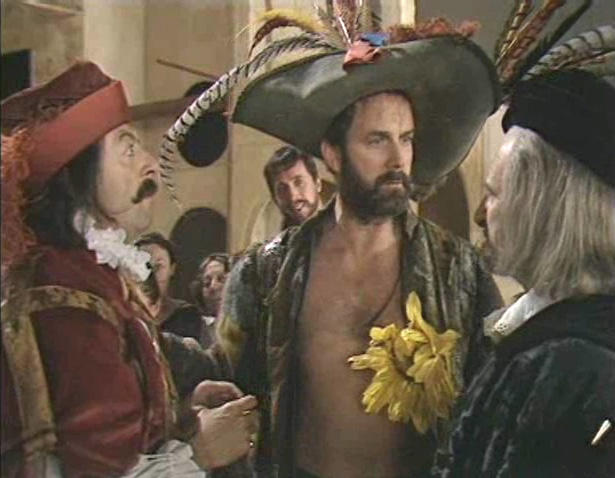
The BBC must have had a similar idea by casting John Cleese as Petruchio.  It’s utterly impossible for me not to hear these lines without a Monty Python spin to them, which is not to fault Mr. Cleese for his Shakespeare but rather to reinforce that casting is an interpretive act.

John Cleese as Petruchio

John Cleese as Petruchio

Indeed, the whole manner of Petruchio’s arrival at the wedding begs for explanation.  For he hasn’t merely shown up in the equivalent of a tux and tails (or whatever the bride and guests were expecting), but in the most outrageous garb imaginable.

Had Petruchio been satisfied merely to strike a financial coop with Baptista, Katherine’s rich father, all he really needed to do was go through the motions, say “I do,” claim his prize and ride off to treat Katherine from then on however he liked.  According to Medieval law and accepted convention, he would have had every right to do so.

We have seen in the negotiation phases of each courtship that in every practical sense they are financial transactions more than matters of the heart.  While Baptista will no doubt be relieved to get cantankerous Katherine off his hands by whatever taker, he first secures Petruchio’s standing and then insists, not because he has to, that Petruchio ought first win her heart.

Oddly enough, he does not insist upon the same conditions for his younger daughter, Bianca.  In the rivalry between Gremio and Tranio (disguised as Vicentio), Baptista declares flat out that he with the richest bid will win the prize.  Make an offer – get the girl.  It’s just that simple.

Or is it?  Shakespeare shreds the accepted practices of his day by exposing them to ridicule in the form of his absurd comic treatment.  Courtship has become such a ritualized dance by his day that it offers him ample opportunity to flout its ritualized norms.

That is, in fact, what I believe Petruchio is up to here.  His outlandish getup reminds me of a scene from Don Quixote.  Imagine the mindset it requires to enter a foreign city to confront your wife’s family and fellow citizens on your wedding day geared up like that.  It takes um, err, guts.  To say the least.

Petruchio makes a bold statement with his actions.  I believe they are meant specifically for Kate, though she does not yet know Petruchio well enough to decipher his behavior.  Here Shakespeare plays with the (sorry, guys) internality and externality of perception – subjectivity and objectivity – to show her that he doesn’t care about how outlandish their behavior appears.  Let people think what they want.  He won’t be trapped by the same suffocating cliches in which everybody else remains content to participate.

He’s reaching out to Kate and saying, “I’ll risk seeming a fool to others if you will.  Step out onto the ledge and we’ll leap out together.  But first, you must learn to read the same language.”  It is precisely these lessons in subjectivity upon which Petruchio now engages.

A long time ago, I learned that Albert Camus described love as “two against the void.”  While I haven’t been able to properly attribute this quote, it has nevertheless stayed with me as the most romantic of all definitions of love.

When Don Quixote tilts at windmills, he is mad.  But if only one other person sees the giants too, well…suddenly it becomes much different.  The more quirky our uniqueness, the harder the quest to find our perfect match, our soulmate, the one other person who looks upon the world and shares our zany visions of white rabbits, a baseball field carved into an Iowa cornfield, every leg of an upcoming U2 tour – or whatever.

Ultimately, it doesn’t really matter what you see but that you see it together.  And I think that’s what Petruchio is beginning to do here, in this act.  He wants Katherine to abandon her reliance upon the convention that has failed her and to adopt a new language that they will develop together.  Let the world believe what it wants to believe.  Behind closed doors, they will reinvent the game from scratch.

So, okay, I am back to my old romantic interpretation.  But two acts still remain.

Interactive Map of Shakespeare’s London

Posted in Context, Shakespeareana with tags on 2014/02/23 by mattermind

I’m not sure what the intellectual equivalent of “cool” is, but whatever it happens to be, this is it.

Talk about Shakespeare’s age deals mostly with abstractions, referencing ideas and history that have receded into historical memory. But there’s nothing like a map to make the past come alive again.

While it’s something less than a Thomas Guide (Do these even exist? Kids, ask your parents.) and not quite a Garmin that will take you to the nearest Starbucks ale house, you will find yourself clicking various places to discover what they were all about.

Start HERE

Until holograms become widely available, I suppose this will just have to do.

Alfred the Great Discovery Rivals Richard III Find

Posted in Context, News with tags , , , on 2014/02/22 by mattermind

Image


It is said that when you learn a new vocabulary word you suddenly see it everywhere.  The same must apply to history because otherwise I would have missed this story entirely.

While all the attention lately has been paid (and rightly so) to the discovery of Richard III’s body buried under a Leicester car park, an even more astonishing bit of history has surfaced with the possible identification of a pelvic bone from Alfred the Great.

This probably won’t mean a whole lot unless you’re either a) British b) an historian c) an archaeologist but nevertheless, if you’re even curious about any of the above you might wish to learn more about why this is so important.

For those who wish to cut to the chase, here are LINK1 and LINK2 to summaries in the British tabloids press.  I know, I know.  I’m as scandalized as you by the graphics and blatant “click me” opportunities.  But somewhere in there is serious journalism and a story worthy of worldwide reporting.

Mind you, as I mentioned previously, I’m new to all this Medieval English history stuff but it doesn’t take a genius to recognize how Alfred earned the nickname.

If you haven’t clicked above (seriously, why haven’t you?) you are now relying on my even briefer and less-informative summation.  But here goes:

a) When England was overrun by large contingents of Vikings, only one kingdom defiantly stood its ground.  Yup, that would be Wessex, led by you-know-who.

b) Alfred learned his lessons both on and off the battlefield.  After near defeat, he reformulated the local armies so barrons would spend half the time away from their domains.  He thought not only in terms of what was best militarily, but what would allow his kingdom to remain vital and productive.

c) He commissioned the first English navy, hitting upon the idea that it might be a good idea to defeat the Vikings at sea before they reached British soil.  While his ship plans weren’t the most seaworthy, he initiated concepts for successive development.

d) At a time when few people were literate outside monasteries, he learned Latin and rounded up scholars to translate texts into the vernacular.  He was especially fond of Boethius’ Consolations of Philosophy and did the work on that text himself.

e) By fathering a competent son, he ensured that his ideas would carry on.  Edward the Elder reconquered the east coast and paved the way for a peace and prosperity under a united England, the first time it had been so since the collapse of the Roman Empire.

So yeah, it’s a pretty big deal.  And okay, so it’s not exactly Shakespeare news.  But I need neither Kevin Bacon nor six degrees to connect the dots. 

Kiss Me, Kate

Posted in The Taming of the Shrew with tags on 2014/02/21 by mattermind

The Taming of the Shrew, Act II

After jettisoning past readings – or misreadings – of the play, I now have no idea where I stand on anything – which is a pretty good place to be.

I have serious doubts now about Petruchio, especially in light of his designs upon Katherine’s family fortune.  He has come to Padua, he says, to “woo wealthily.  And if wealthily, happily.”  He has set his sites on Katherine even before having met her.  He believes that the prospects of gold offset any prospective difficulties with her catty disposition.

The sense I get so far, in fact, is more about the commodification of marriage than anything else, the negotiations that take place over dowries and standing – what it takes to win the right to a daughter’s hand from a calculating father.  Though I am touched by Baptista’s (Kate’s father’s) concern that Petruchio must first win her heart.

Indeed, the dialogue between the two aspiring lovers when they first encounter each other still gives me hope that appearances are deceiving. Along those lines, I must also resolve why Kate consents to marriage with Petruchio if she has any misgivings.  Her father so much as states that without her acceptance, there will be no betrothal.

Which leads me to the more difficult question of why Kate is a “shrew” to begin with.  What occurred during the backstory to make her so?  What did it take to initially piss her, the eldest daughter, off?

We get some clue in an odd scene between Kate and Bianca at the start of Act II when Bianca attempts to figure out which of her suitors has made Kate envious.  We understand it must be hard for the elder sister to watch Bianca heaped with praise and sought after by so many eligible men; she is considered the crown jewel, while Kate is relegated to being an impediment to Bianca’s social advancement.  But one also wonders – it’s nowhere in the text, yet still – if the circumstances might have been different had the girls’ mother been around?

In fact, Kate vents deep-seated anger at her father when she says:

KATHERINE: What, will you not suffer me? Nay, now I see

She is your treasure, she must have a husband,

I must dance barefoot on her wedding day

And, for your love to her, lead apes in hell.

With so much character below the surface, hidden in the subtext, it makes Taming a truly difficult play to analyze and explains why opinions vary all over the map.  One must posit conjectures and see if they are borne out by the text.  But wouldn’t a close relationship with the unseen mom partially explain why Baptista is so patient with Kate?  Why he will give anything to the man who can make her happy?  Or does he just want to get rid of her?

Frankly, I give Shakespeare the benefit of the doubt here and elsewhere until proven otherwise.  He has earned that degree of trust from me – I’m not just granting it because he’s “Shakespeare.”  We have already seen in The Comedy of Errors – an earlier play than Shrew – that he makes a point of putting strong, passionate, opinionated women front and center.  Therefore, before I succumb to the misogynistic label that some bandy about, I am determined to remain open-minded until I am persuaded one way or the other.

That first exchange between Petruchio and Kate intrigues me.  Her anger spews, yet much sauciness gets expressed between the lines, sexual tension and frustration that can better be conveyed by actors than by merely reading it on the page.

Are both Kate and Petruchio changed by this encounter with one another?  Each has come in with entrenched expectations: Kate, that her reputation precedes her, that this will be yet another queasy suitor who’d rather be pursuing Bianca.  Petruchio has steeled himself for a wild bullride, but I think he’s pleasantly surprised by Kate’s wit and energy.  He craves the challenge.  But more than this, I believe that he begins to actually want Kate.

Now this puts me back on the romantic path. I must check myself here before declaring myself of any one particular opinion.  But I am reminded of a scene from a recent movie I love so very much.  It conveys a similar sense of determination by a man not dissuaded by the causes that have kept other wooers away.

Does this same spirit pervade Shrew?  Or maybe, alas, it’s just me.

http://www.youtube.com/watch?v=AFzddmFWwes