Archive for February, 2014

Cymbeline: An Introduction

Posted in Cymbeline with tags on 2014/02/20 by mattermind

While I normally frown upon mixing plays, I wanted to preface March’s turn toward the histories by sharing an audio program I have begun from the Great Courses.

I am not being sponsored by them; I just happen to be a huge fan. So when it came time to making a crucial decision about how to tackle Shakespearean history, I went the unusual route of following the historical chronology rather than the order Shakespeare wrote them.

While I am curious about Shakespeare’s development as a playwright, I am even more eager to eliminate a blight in my own education. Because of my fascination with intellectual history, I have habitually followed the collapse of Rome with Charlemagne, the Holy Roman Empire, the Italian Renaissance and then the Enlightenment, leaving a near complete absence of the very material that this course covers.

Forgive my innocence, but I really had no previous understanding of English vs. British history, how the Scots and Welsh preserved their independence, or how the Irish “saved civilization.” From the development of Christianity, to feudal kingdoms and parliamentary law, I honestly had no grasp on the full extent of my ignorance.

Here is the video intro to the course that I am studying in 36 audio instalments. If it plays like an infomercial, well, that’s basically what it is:

https://www.youtube.com/watch?v=00Nt-TuoYxQ&feature=youtube_gdata_player

Now I understand the historical background of Cymbeline. I’m not sure how much it will help me figure out the play, but at least I have a running start.

[Note: Hamlet, King Lear and Macbeth have been removed from the chronology so they can be read sequentially later on. While they each have a historical component as well, their literary legacy transcends time, comprising the single greatest hot streak any author has ever achieved – as we’ll discuss later.]

I can’t tell you how exciting this is! Shakespeare has already led me down paths I never expected to follow, becoming an entire education unto himself. It’s a journey I heartily encourage you to take up for yourself.

And now we return to our original programming.

Shakespeare Author Controversy Still Rages

Posted in Author Controversy on 2014/02/19 by mattermind

Here’s a LINK to a story blog post in the Washington Post defending Shakespeare as the author of the plays we normally ascribe to him. It’s notable for many reasons, especially the heated debate that follows in the comment section.

As a longtime reader of the Post (I did my grad work in Annapolis, not far from DC), I couldn’t help but notice a radically different feel to the article blog – perhaps because I haven’t paid much attention in awhile. (Or because it’s a blog…hello!)  The story cited few facts, but rather conveniently referenced a work available for Kindle devices (the Post is currently owned by Jeff Bezos, the founder of Amazon.com).

I will refrain from further fanning the flames of controversy by claiming a conspiracy theory within a conspiracy theory.  But the Shakespeare authorial question itself is too persistent to ignore, least of all on a blog like mine devoting itself  to the man and “his” works.  Over the course of the year I plan to revisit the wider arguments for and against, particularly  as information bubbles up to reach public consciousness in the form of our popular media.

Lately, for what it’s worth, I have been swayed more by the Stratfordians than the Oxfordians (those who believe the Edward de Vere, the Earl of Oxford, is the man behind the Shakespeare front).  But as I have shown with Richard III, I remain open to a persuasive argument either for or against.  I hope to set aside time to look deeper into the Oxfordian side of the story, especially in light of a new angle mentioned in the comments that I had never heard before.

This has to do with what is known as the “Shakespeare Apocrypha,” plays of dubious quality allegedly written by Shakespeare that were credited to him during his lifetime.  I’m new to this concept so don’t hold me to anything until I figure out how this whole thing works.  But the gist of it seems to be that the Stratfordians can’t have it both ways.  Either Shakespeare wrote the genius plays AND the crap OR the authenticity of Shakespearean attributions is all screwed up.

Like I said, there are wheels within wheels here in what amounts to a heated debate both pro and con.  All you need to do is click on the link above and sample some of the discussion, which we shall delve deeper into as the Year of Shakespeare unfolds.

Two New Portraits of Shakespeare Found?

Posted in News, Shakespeareana on 2014/02/18 by mattermind

We have so few authenticated images of Shakespeare that any report of a new discovery is bound to draw worldwide attention.  Over the last few days I have become aware of not just one, but two of them – one from Shakespeare’s early playwriting career and the other from his days of leisurely retirement.

The First is known as the Wörlitz portrait and features a young man brimming with confidence:

Worlitz Portrait

The second is called the Boaden portrait (featured on the right) and renders a gentleman who has acquired a good measure of comfort and ease:

New Portraits

PHOTO CREDIT: See German link below

There is solid scholarship behind the assertions, coming from Hildegard Hammerschmidt-Hummel, a noted professor of English at Mainz University, Germany.  (That is her seen standing between the two portraits.  For a full recap in German, click HERE.)

She has been on the prowl for authentic images of Shakespeare for over 20 years!  For those seeking more information, her WEBSITE offers much to explore in both German and English.

“I subjected the images to fundamental tests of identity and authenticity, and these revealed that we are dealing with true-to-life portraits of Shakespeare, one from his youth, the second from his old age,” Hammerschmidt-Hummel told Discovery News. (For the full story in English, click HERE.)

With such solid scholarship behind the recent announcements, there is a good likelihood that these two new images will stand the test of time, helping round out a pictorial timeline stretching from Shakespeare’s ambitious early days as a young actor and budding London playwright through his latter luxury as an accomplished gentleman in Stratford.

I will update this site as more information becomes available.

Who’s Afraid of Bianca’s Sister?

Posted in The Taming of the Shrew with tags , on 2014/02/17 by mattermind

The Taming of the Shrew, Act I

After downloading and listening to a lecture series on Shakespearean comedy, I may have to rethink my premises.

Taming has long been one of my favorite plays, but now I wonder if that’s because of a hyper-romantic young man’s misunderstanding. Now that I’m a little older, I must re-read the play yet again, this time prepared to surrender everything I thought I knew.

I used to believe that there were parallels between Shrew and Edward Albee’s Who’s Afraid of Virginia Woolf, especially in the comparison of couples that meet and defy convention.

For this gloss to work, a real love relationship must be established between Kate and Petruchio that connects beyond the surface lessons in wifely subservience.

In the excerpt below, I love the impact of the early-morning revelation, the first of many to follow as the booze wears off and the games come to a crashing halt. We realize that these relationships are nothing like what they first appeared and that true love is a lot more complicated than most of us are willing to admit…or stand up and fight for.

But is this what’s happening in Taming of the Shrew? Or have I seen only what I wanted? What is Shakespeare really up to? Are there any lessons to be drawn – or couples to admire – in this play within a play?

The hard questions have only just begun.

https://www.youtube.com/watch?v=PgMu5oM4rUg&feature=youtube_gdata_player

10 Curious Facts About Shakespeare

Posted in Shakespeareana on 2014/02/17 by mattermind

Normally these are fairly generic and often throwaway, but the bit about the pipe is news to me and Much Ado About Nothing just took on a whole new meaning.

https://www.youtube.com/watch?v=ZEWA59LAIjg&feature=youtube_gdata_player

The Tao of Shakespeare

Posted in Context with tags , , , on 2014/02/16 by mattermind
Illustration of the Four Humors from Wikipedia

Illustration of the Four Humors from Wikipedia

Yesterday I set off in search of a better understanding of the humors – Melancholic, Sanguine, Phlegmatic, Choleric – and how Shakespeare employed them to shape his characters.  Today I am reminded of one of my favorite books: The Tao of Pooh by Benjamin Hoff, and how these two disparate streams of thought may very well be related.

In the Tao of Pooh, Tigger, Winnie, Piglet, Owl and Eyeore are shown to embody particular personality types: Owl is the thinker, Piglet the worrier, Tigger the optimist, Eyeore the pessimist and Winnie the Taoist who bumbles happily along as “a bear of little brain.”

Tao of Pooh

This seems comparable to how Shakespeare considered personalities based upon the four “humors,” a Greek concept that endured well past the Renaissance until human bodies were finally allowed to be dissected and thereby mechanistically understood, transforming the philosophy of medicine.

According to the ancient approach, there were four dominant “types” or humors (as mentioned above).  Here is a famous example from the era, Robert Burton’s legendary Anatomy of Melancholy as featured in the display case at the Norris Medical Library at USC.

The Anatomy of Melancholy by Robert Burton

The Anatomy of Melancholy by Robert Burton

Yet who expresses Melancholia better than this guy?

Eeyore

Similar comparisons can be made with the other humors. Here is a chart on Choleric from USC:

Choleric

The Taming of the Shrew was offered to illustrate, but I think the point could just as easily have been made by this fellow:

Rabbit

The Phlegmatic type is characterized by being centered in the mind. Who conveys that better than this guy?

Owl

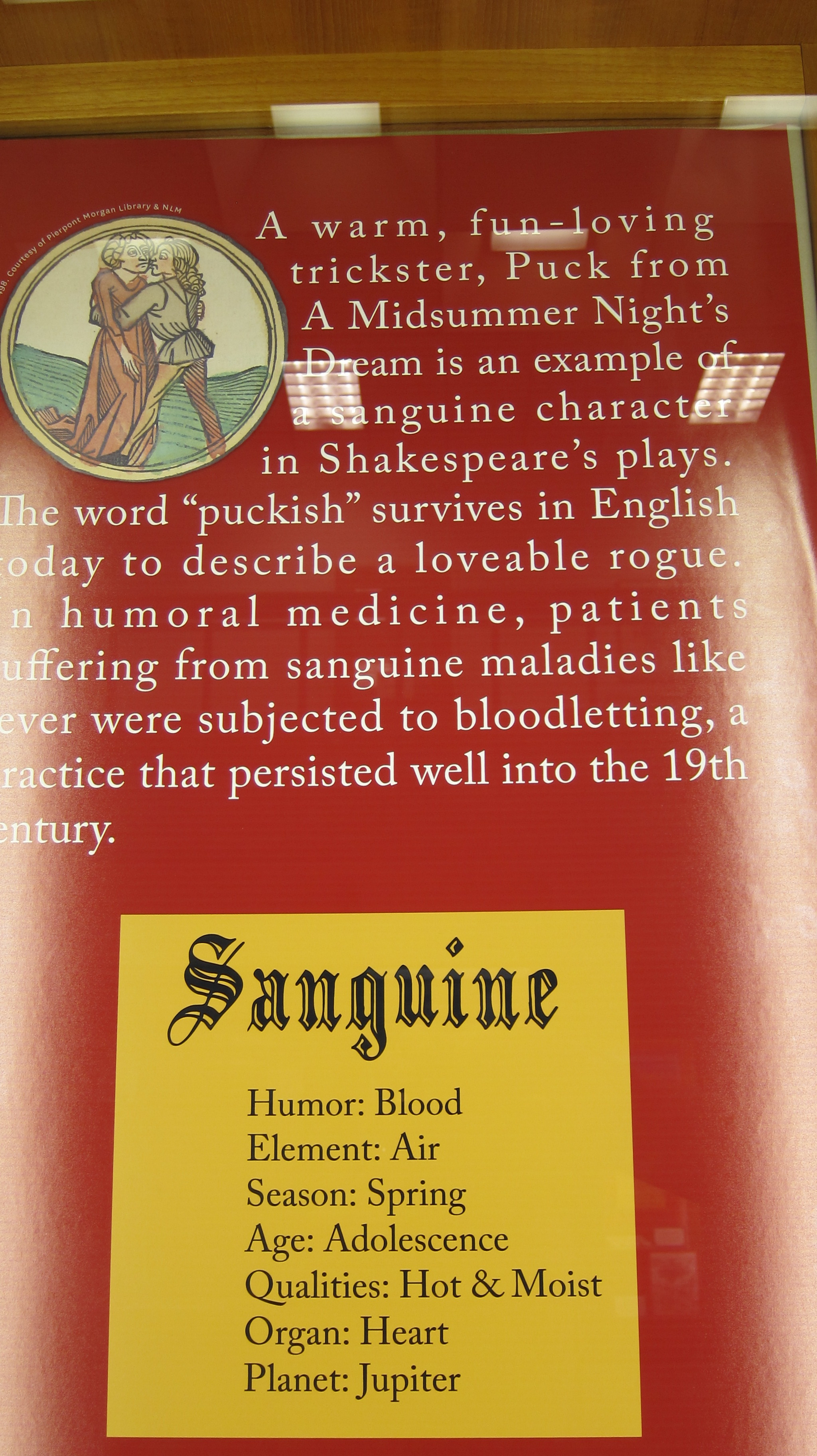
My personal favorite humor is Sanguine. Here is a shot of the display case from the Norris Library. (If not for the glare, I would have used more of these in this post.)

Sanguine

For my money, nobody embodies that attitude better than:

Tigger

There are many ways of considering Shakespeare and the humors.  This is just one of them.  My post in no way intends to make light of a serious historical concept, but rather tries to simplify what can otherwise seem obtuse and impenetrable by making connections to contemporary personality types that are universally familiar.

Medical philosophy has come a long way since physicians utilized blood letting and bile sampling in order to diagnose and treat “ill-humored” patients.  While the basis for these ideas still lingers in Chinese medicine and what are now considered “alternative” remedies, we all retain a semblance of such broad characteristics when assessing the behaviors of friends, colleagues, acquaintances, and strangers.  They even help us gain insight into ourselves.

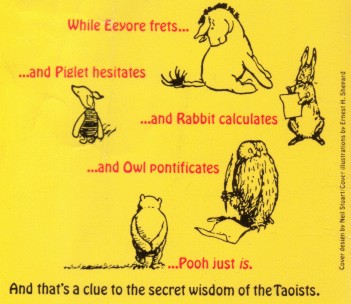
The Tao of Pooh puts it best:

Pooh Philosophy

Upon My Life, I Am a Lord Indeed

Posted in The Taming of the Shrew on 2014/02/15 by mattermind

The Taming of the Shrew, Induction

As I write this, I am riding the Metrolink back home from a trip to the USC medical campus to see a display on Shakespeare and the four humors before it closes.

For the measly sum of only $10, I was able to ride the rails and buses of Los Angeles, allowing me to shop for Shakespeare in one of the last great used bookshops, buy the best garlic bagels in Southern California, walk by Olvera Street and catch the exhibit before heading back.

I learned lots about the humors from a decidedly medical point of view and was surprised to see The Taming of the Shrew given as an example of choleric – being all hot and bothered. (More on that later.)

I thought all those rides would provide a great opportunity to read the play and post a bunch, but it turns out I’m confounded at the getgo by the strange introduction and need to write my thoughts out before moving on.

First off, why is the dammed thing even here? The BBC saw fit to delete it from their well-regarded filmed series of all the Bard’s works. But on what grounds?

Seems to me that’s the easy way out of a perplexing conundrum that Shakespeare purposely set up. For to read the text literally, Taming is not the “real” play but rather a play within a play – and a production put on for a prank no less.

In the preface, we meet Sly (hmm…), a drunkard who passes out after engaging in a disagreement with a bar wench. A bored Lord saunters by and decides to have a bit of fun.

He takes the boozer home under orders to treat him as regal upon waking, to convince him that his former wastrel life was but a dream.

At the risk of writing the longest post of the year, this reminds me of a story Mr. DuPratt used to tell us in high school about his favorite writer, Ambrose Bierce.

Bierce, he said, was fascinated by the idea that a person could become anybody he or she wished by leaving town and changing identities. Who we are is just a custom, a habit as easily cast off as a snake’s skin. It happens all the time in witness protection programs.

But if that’s the case, what is real about who we are? Not only is this important for understanding the introduction, but I will argue that it matters when attempting to understand the nature of Kate’s “shrewishness” and love as well.

I’ll leave it at this for now. But shame on the BBC for assuming they could just lop off the inconvenient bits and carry on. Shakespeare included the sly introduction for a reason!

And that’s because the nature of reality and identity are inseperably linked within this play.

Animated Tales: the Taming of the Shrew

Posted in The Taming of the Shrew with tags , on 2014/02/14 by mattermind

I hope you find this as delightful as I do. There are quarrels to pick regarding Kate’s docility at the end that we will address later. But for now it serves as a quality introduction. Kudos to the talented creative team behind it.

I love how this condensed version includes the drunken, prankish preface that even the BBC leaves out for what can only be supposed as thorny, philosophical reasons.

https://www.youtube.com/watch?v=neRpMkdIFco&feature=youtube_gdata_player

Dromio, Dromio! Wherefore Art Thou Dromio?

Posted in The Comedy of Errors with tags , , , on 2014/02/13 by mattermind

The Comedy of Errors, Act V

Way back in Act II, I promised I would return to Adriana and address the fascinating dialogue she has with her sister, Luciana, regarding the nature of marriage.  I do this now both as the fulfillment of a promise and as a prelude to Valentine’s Day and The Taming of the Shrew.

Even farther back – yonder, at the beginning of the year – I broached this subject by meditating on the role of Desdemona in Othello.  Were her actions heroic?  Or those seen all too frequently in modern times by women suffering from battered-wife syndrome?

For three plays running, women – just like in horror films – have been the victims of male violence.  In Othello it was Desdemona, In Titus Andronicus, Lavinia.  In Richard III, Anne.  To borrow an archaic usage, the fairer sex has not been “used” well by men thus far.  But does that make Shakespeare a bad guy?

The worst class I ever endured, bar none, was a core humanities requirement at UCLA.  Throughout the entire semester i sat on my hands, attempting to restrain myself while an angry professor took it upon herself to correct 3000 years of canonical literary domination by men.  While I feel it necessary and vital to widen the discourse and make the Great Conversation available to all, I draw the line when the creative titans  of history – Homer, Virgil, Chaucer, Dante, Shakespeare – are subjected to critical assault for perspectives that seem too easy a target from a 21st-Century perspective.

If Shakespeare was a misogynist, then by all means, take him down a peg or three.  But is that really what the texts reveal?  Or his biography?  Peter Ackroyd suggests that if anything, Shakespeare had a strong, resourceful mother who exerted a powerful influence upon the boy and young man.  She taught him by example that women could be confident and clever.

Why else would actresses flock to Shakespeare’s plays – just for the steady work, perhaps?  And yet we so often hear about the complexity of his female characters, the range of expression he offers, especially compared to today’s bimbos and video-game sex kittens.

I’m not claiming to have the answers here.  But it’s certainly a subject that needs to be addressed, not just now for one play, but over the span of the year covering the gamut of Shakespeare’s works – the poems and sonnets as well.  Let’s see what the actual writings convey.  [If you, dear reader, wish to participate in a discussion or pen a guest blog, the forum is yours.]

But as for Adriana and The Comedy of Errors, I must confess that her actions bespeak a complex, complicated woman who seems plenty strong and outspoken in the company of her sister and husband, yet who backs down at a crucial moment when the Abbess confronts her about accepting blame for her husband’s apparent madness.

During the early dialogue in Act II, Adriana expresses vexation at having to wait upon Antipholus to return at his own leisure, while her sister defends this tardiness as the sole prerogative of men.

ADRIANA: Why should their liberty than ours be more?

LUCIANA: Because their business still lie out o’door.

ADRIANA: Look, when I serve him so, he takes it ill. 

LUCIANA: O, know he is the bridle of your will.

ADRIANA: There’s none but asses that will be bridled so.

LUCIANA: Why, headstrong liberty is lashed with woe.

There’s nothing situate under heaven’s eye

But hath his bound, in earth, in sea, in sky.

The beasts, the fishes and the winged fowls

Are their male’s subjects and at their controls.

Man, more divine, the masters of all these,

Lord of the wide world and wild, wat’ry seas,

Endued with intellectual sense and souls.

Of more preeminence then fish and fowls,

Are masters to their females, and their lords.

Then let your will attend on their accords.

ADRIANA: This servitude makes you to keep unwed.  

This hardly sounds like a docile, passive woman content to be restricted by her husband!

There are, however, social conventions and expectations that Shakespeare could not avoid.  (This will come up again more prominently in Taming of the Shrew.)  Adriana may back down at the withering accusations of the Abbess, but that doesn’t stop her from taking measures to retrieve her husband from that lady’s care.

She wastes no time trying to bail out Antipholus from his debts.  She directs her men to seize him so he can be taken home and administered to by Doctor Pinch.  And she appeals to the Duke for justice once Antipholus flees (his twin, actually, but it’s hard to keep up) into the Abbey.  In short, she never allows herself to be a victim of circumstances – not even in the backstory when, again, according to the Abbess, she should have meekly tolerated her husband’s alleged affair.

Shakespeare may not be perfect when it comes to his portrayals of women.  He is a bawdy prankster who loves his sexual puns and banter.  But the women he created run the gamut from serving wenches to grieving widows, lusty strumpets to loyal housewives and spiteful queens.  In Othello, it was Iago’s wife, Emilia, who took the bravest action in the drama by standing up for the moral right when others wouldn’t, even knowing it would cost her life.  If Desdemona exemplifies the purest love, then Emilia personifies the most heroic bravery and selflessness.

Argue whatever position you wish about Shakespeare.  But call him a misogynist and I will take you to the mat.

For the record, I earned a C- in that humanities class at UCLA, the lowest in my entire academic career.  By today’s lax standards, that should be regarded as an F.  And I have absolutely no regrets about it whatsoever.

Here We Wander in Illusions

Posted in The Comedy of Errors on 2014/02/12 by mattermind

The Comedy of Errors, Act IV

Each of the four plays that I have read so far has involved the misapprehension of reality to some degree.  In Othello, Titus Andronicus and Richard III, the truth is manipulated for temporary advantage – and ultimately tragic ends.  In The Comedy of Errors, the driving force is not a man’s malevolence, but strange twists of fate.  And the results are not murder and mayhem, but laughter, love and family reunion.

In Act IV, the farce is stretched to its breaking point.  Antipholus of Ephesus is arrested for failure to pay a debt, his wife thinks him mad, Dromio chastises him (with right) for being cruel, Luciana believes him to be a scoundrel (even if she might not mind were he not wedded to her sister) – and now he’s headed for jail.

The fortune that flees this Antipholus fattens up his twin from Syracuse who can’t help but marvel at his good fortune.  Women throw themselves at him, strangers hand him gold chains and purses of money, people greet him warmly wherever he goes.  From his perspective, this place must be bewitched.  He can’t wait to set sail with his booty intact at the first opportunity.

Perspective thus becomes a key to understanding how Shakeseparean drama works.  For there always seem to be multiple meanings at play, variances of awareness and clashes of mis/understanding – dramatic ironies, if you will, from the audience’s point of view.  Some characters know things that others do not.  We know things that the characters do not.  And Shakespeare knows things that we do not.

Maybe that too is another reason that we hold Shakespeare to be such a master.  For our actual lives exist on a variety of competing levels, only some of which we are aware of at any given moment.  We create our own fortunes and yet find ourselves the victims of cruel circumstances.  Things happen for reasons we never fully comprehend.

For the span of a play, Shakespeare allows us the luxury sit back and enjoy a complex web of destiny spun around other people.  We, the theatergoers, are in on the joke.  We hiss at the evil doers, cheer for the heroes, yearn for star-crossed lovers to hook up, knowing the whole while that Shakespeare’s got it all under his control. 

We’re in good hands, even when the world outside the theater can seem a little…well… shaky.

[Exit, pursued by a bear.]