Archive for the The Plays Category

Shall We Be Merry?

Posted in Henry IV Part 1 with tags , , , , , , , on 2014/04/10 by mattermind
Source: Forbes.com

Source: Forbes.com

Henry IV: Part I, Act II

Stepping into Henry IV is like entering a whole new story universe. I’ve never been quite so dazzled by anything this quickly; after much deliberation, I think I know why.

Writers often speak in terms of either “plot-driven” or “character-driven” narrative, with the conclusion inevitably being that they must be a fusion of both.  But at the end of the day, we can usually tell when what we’re reading or watching is plot-heavy (Dan Brown, The Expendables), or character-dense (anything by Aaron Sorkin, Edward Albee or Tennessee Williams).  Every once in awhile, your peanut butter gets mixed up in my chocolate, and everybody leaves satisfied (Joss Whedon’s Avengers).

And then there’s Shakespeare.  Most of his plays register high in all aspects of the Prichard scale, with some like Romeo & Juliet (which we’ll get to shortly) being both long on adventure and romance as well as interweaving a suspenseful, complex plot.

Henry IV takes this to a whole new level.  I say that because of the sheer quantity of character voices and personalities, each with a different tangy slang to their accent and outlook.  Stable boys, scoundrels, tax collectors, bar maids, chambermaids, kings, rebels, upstarts, barons, wives – they’re all here in spades and we’re only in Act II!  Not only are they here, but Shakespeare seems to revel in their boisterous individual speech and bluster.  They tell off-color jokes, insult one another with abandon.  Dialogue is saturated in subtext in the context of a festering civil war, lingering disappointment between father and son, the disillusionment of a big-hearted, petty thief, a regal heir sowing oats before inheriting the heavy responsibilities of the throne.  This is three-dimensional chess on a moving chessboard.  And a patient, deliberate artist willing to take his sweet time in delivering a corker of an action climax.

We can see it brewing in the background, a showdown between playful Prince Hal and hotheaded Hotspur.  It’s as though Hal were Luke Skywalker, passing his time on far-off Tatooine while Darth slowly strangled the rebel alliance.  You know they are headed for an epic clash.  So why not sit back and enjoy the ride?

This has all the elements of a Sergio Leone spaghetti western.  Henry IV is beset by a legion of rapidly uniting forces intent on overthrowing his rule.  These aren’t just any old cantankerous dissidents, but a collection of legendary and profoundly powerful forces.  Henry IV has grown old and weary, yet he will attempt to rise to the challenge.  But it’s going to take somebody younger, a son with great, untapped potential to complete the task.

Here are my favorite lines:

FALSTAFF: But tell me, Hal, are not thou horrible afeard? Thou being heir apparent, could the world pick thee out three such enemies again as that fiend Douglas, that spirit Percy, and that devil Glendower? Art thou not horribly afraid? Doth thy blood not thrill at it?

PRINCE HENRY: Not a whit, i’faith; I lack some of thy instinct.

Marvel comic books wish they had tales this gripping.
When Thou Art A King

Posted in Henry IV Part 1 on 2014/04/08 by mattermind

Henry IV Part I, Act I

I’m not exactly sure why it has taken me so long to wrap my head around this particular play.  Now that I have a reasonable handle on it and have begun to make inroads, there is nothing drastic going on besides a lengthy and convoluted backstory that takes Twister-like maneuvers to follow.  Especially when what most stands out about the first act is the less-than-stunning revelation how perilous it is to be king.

UPDATE: The depth of the play lies in its rich characters and dense plot.  Prince Hal and Falstaff transcend the confines of the story to achieve literary universality.  Not to mention the tragic built-in ironies confounding Henry. So yes, there is much to appreciate (and navigate) herein. It’s a chewy cookie (but so moist and flavorful).

When we left Richard II, he had been deposed by Henry and murdered by an overeager acolyte, casting a shadow of impending gloom over the dawning sequel.  It only takes the opening lines of Henry IV Part One to reveal that this has indeed happened.

KING: So shaken are we, so wan with care,
Find we a time for frighted peace to pant
And breathe short-winded accents of new broils
To be commenced in stronds afar remote.

Boom! Henry is besotted from the get-go with woes virtually identical to those that plagued Richard.  Sweet irony! For we are reminded again and again how obsessive (fussy, overbearing, insufferable?) the English can be about legitimate succession.  These sorts of issues are the mandatory blowback, apparently, of trying to preserve a monarchy while accommodating a burgeoning parliament filled with ambitious barons and expanding the tenuous rule of law.  A fussiness quotient gets added to an already incendiary mix, trying to balance partisan barons, a rowdy public, a dominant clergy and rival rulers.  Constant warfare created the need for what could become unbearable taxation.  Even without the modern trappings of 24/7 media and opinion polls every news cycle, the king battled incessantly with competing factions.

He may not have suffered from the same extensive overreach as Richard (failures at war, excessive taxation to fund failed campaigns, insistence upon liberties with court wives), but he wasn’t the first to be felled by the yawning gap between running an upstart campaign and the complications of having to actually rule a country.

Why in the world would anybody wish to be king under those circumstances? There were (and still are) many perks, of course.  The position paid handsomely and marriage posed no barrier to dalliances.  Like a mob boss or CEO of an international conglomerate, the living is good but the term may be short and the fall steep.

Henry is besieged both personally and politically. Personally in the form of his wayward son, Prince Hal, a kid more fond of hanging around miscreants like Falstaff than grooming himself for eventual succession.  He is contrasted with Hotspur (great name!), a feisty, enterprising, talented idealist who stands in opposition to Henry but embodies similar values and characteristics to the young Bolingbroke (the future Henry) we met back in Richard II.

Wheels within wheels…what goes around, comes around.  And now a plot is hatched to unseat Henry the same way that Henry deposed Richard.  Will the young Prince Hal mature in time to inherit the kingdom? Or will Hotspur’s crew avenge the “betrayal” they’ve suffered since supporting Henry’s rise to the top?

Getcha popcorn.  This is gonna be good!

You Can’t Handle the Truth

Posted in Context, Henry IV Part 1 with tags , , , on 2014/04/07 by mattermind

In trying to make sense of Henry IV, I’m forced to confront larger issues that drive much deeper but are merely tangential to the play.  For instance, how much should the truth matter, especially when these works in particular are called the histories?

I have touched on this subject while reading Richard III.  But now it rears its ugly head again in a big way and I’m not sure what to make of it.  Isaac Asimov, for instance, points out that Prince Hal and Hotspur enjoyed more of a father-son relationship than that of rival brothers.  In fact, Hotspur was two years older than King Edward himself.

It seems Shakespeare couldn’t resist making changes that any modern screenwriter would nod and sympathize with.  These are the very points of contention that critics and fans of the novel (or historical accuracy) will inevitably bring up while slamming the said work with such comments as, “This isn’t anything like the book,” or, “That’s not how it happened.”

Well, Edward IV is another example of this, only by now so much time has passed that the actual history serves almost as a footnote, a marginal amendment applicable to scholars and wonks only.  For the rest of the civilized world, what Shakespeare dramatized has become the gold standard, interchangeable for truth.  But should we be concerned about that?

One could argue that, in making the changes, Shakespeare aspired for dramatic truth – a different form of truth, naturally, but the one nearest to his heart and talents as a playwright.  Why should he concern himself with getting all the niggling details correct?  Especially when that would mean the sacrifice of a good metaphor, irony or parallel construction.  Fudge here, compress there.  That’s how the game works.  And any reasonably literate audience ought to know that.

So why bother calling them the histories then?  Why not fictionalize them entirely, invent characters wholecloth or “based on a true story” instead of trying to have it both ways by capitalizing on the general public’s vague understanding of real events and then distorting them with hyperstylized dialogue and action?

Ultimately, I cannot escape the gravity of this rhetorical black hole.  Shakespeare wrote the plays that we call the histories which historians know are based on errors of source and errors of choice.  But then there are the plays, masterpieces unto themselves.  Why rail at Shakespeare when we can benefit from both with a little education or insight?

Scheduling Update

Posted in Henry IV Part 1, Syllabi with tags , on 2014/04/05 by mattermind

Something Orson Welles said about Falstaff (see yesterday’s blog post) slapped me in the face and caused me to completely revise my schedule for the month of April.

Late in the clip, while discussing the bloody battle scene, he remarks that this moment divides the middle ages and the modern (or something to that effect). Neither war nor human psychology would ever be the same.

His thoughts deserve revisiting, and this cycle of plays cries out for in-depth study and analysis. I’ve reached one of those places on my Eurail tour when I must put down roots or risk turning the entire journey into a farce.

You can’t rush ancient Rome or Prague or Vienna or Budapest. I haven’t embarked on studying Shakespeare merely to rubberstamp my passport with a few colorful entry visas.

I have vowed that when I encounter a mountain I shall climb it. Here is such an Everest and Kilimanjaro. The extra effort required to ascend its peak will be worth it. [Peter Matthiessen died today. R.I.P., dear remarkable soul.]

Therefore I have shoved Henry VI until later, bookending it with Henry VIII. Thematically this actually makes sense because it juxtaposes one of Shakespeare’s earliest plays with one of his last. I look forward to a side-by-side comparison.

April now transforms into the “Henriad” or my own personal Hollow Crown adventure. In keeping with that spirit, I have ordered the complete DVD series.

Yup. I’m excited. I love when my assumptions are challenged, my thinking expanded by new doorways that demand venturing through.

April has taken on a whole new meaning.

The Enormity of Falstaff

Posted in Henry IV Part 1 on 2014/04/04 by mattermind

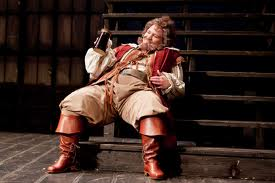
Falstaff

In attempting to wrap my mind around Shakespeare’s titanic Henry IV, I have encountered a profound detour that I never expected. Turning to my dear Sir Isaac Asimov, my guide throughout this project, I discover over one hundred pages of a tome encompassing all the plays has been dedicated to Henry IV, Parts I & II alone.

Dissertations have been written on the character of Falstaff, so I will leave it to Mr. Orson Welles to provide our introduction:

I mentioned previously, rather tongue-in-cheekily, that the pattern of Shakespeare’s history plays had become all-too predictable.  Succession issues dominate, with the result that we come to understand that the crown sits precariously on the head of any man (or woman) who wears it.

Yet were these intended to be moral fables? Are we meant to draw lessons from them that can be applied to the present?  Shakespeare’s present? Ours?  In pouring through Shakespeare biographies, I have learned that the art of playwriting itself has had a moralistic evolution, being shaped by the pedagogical impulses of the Church.  That is, after the end of the classical period, of course, and the rise of the middle ages. It was expected, leading up to Shakespeare’s age, that staged fables would portray virtue and vice, sin and redemption, impart aspects of dogma to the large swaths of the population which could not read or write (and who may have avoided quasi-mandatory church service).

That was all radically changing, especially in cosmopolitan centers such as London.  But Shakespeare elevates his aim to a whole new level.  His plays don’t just summarize life or render it in homilies or pave it into pat clichés. No…somehow, rather, through his genius for the invention of characters, he holds a mirror to life and projects it onto the stage in three dimensions.  He presents us with complete beings such as Falstaff and Prince Hal, men (and women) who are burdened with mighty faults as well as gifted with soaring abilities, multi-layered, multivalent beings driven by complex motivations.  We cannot flatly state whether they are either good or bad, wearing a white hat or black.  They don’t represent a type.  In Shakespeare’s hands they become a type unto themselves.

Thus, we can drop the names Lear, Hamlet, Othello, Macbeth, Romeo, Falstaff and they mean something, stand for a unique person as well as idiosyncratic way of being.  There is no other writer in any language for whom it can be stated so unequivocally and triumphantly that he invented an entire spectrum of characters who have become as real to us through time as anybody who ever lived.

Henry IV or Bust

Posted in Henry IV Part 1 on 2014/04/02 by mattermind

Henry IV, an Introduction

I have entered strange, new territory with Henry IV – and clearly I’m not prepared. I read and reread Act I trying to make sense of it, but there are simply too many moving parts to comprehend the whole at first go.

I’m wondering what happened, how the heck Shakespeare pulled the rug out from beneath me so suddenly. I expected such an easy transition from Richard II…after all, King John and Richard had proven relatively straightforward, even a tad staid and underwhelming (if ever Shakespeare can be that). Now, as if to remind me what an overwhelming force the Bard can be, I face complexity within complexity, like a schoolboy encountering him for the first time. I’m scrambling for a roadmap, a map to the stars, a way to contextualize the plot, the characters, the motivation…everything!

How in the world did this happen? I’m going to have to retrench my approach to this set of plays, hunker down as if studying for college midterms. This may very well be the dreaded downside to having chosen to read the histories in chronological rather than written order. I haven’t encountered a multi-part plot before this (Henry VI being the first that Shakespeare wrote, which I’ll only get to later).

Clearly Shakespeare has upped the ante and deepened the game. This, kids, is a warning against the decision I made. For it’s almost as though I were dealing with a completely new author; his craft is now engaged at full tilt. I feel as though I’ve been ambushed, caught in a heavy intellectual crossfire, overwhelmed and outmatched by superior linguistic and substantive forces. Or, shorter: I have literally no idea what’s happening – or why.

To be honest, I knew I had ventured in over my head the moment I got a gander of the cast of characters. Everyone with a smattering of Shakespeare knows that Falstaff is one of his greatest creations. I had been so looking forward to meeting him that I forgot that he came wrapped in a two-part history, assuming – rather arrogantly and falsely – that our introduction would be a breeze, more like running into Romeo for the first time than, say, Hamlet.

Boy was I wrong! As a result, I am caught with my britches slung around my ankles, undressed by the boldness, complexity and uniqueness of the individual voices assaulting my comprehension. Somewhere Harold Bloom is laughing.

Call this then my complete whiff at Shakespeare, a brush (not the first, and certainly not the last) with abject humility.

I am left utterly speechless…breathless…gasping…lacking anything substantive to say. (Though wags may argue this awareness should have dawned long ago – and that I just missed it.) I feel it now though – oof. This one hurts. My kingdom for a credible metaphor.

I will rise to this challenge. But first I must find a way into the play…and fast!

Richard II Explained

Posted in The Plays on 2014/04/01 by mattermind

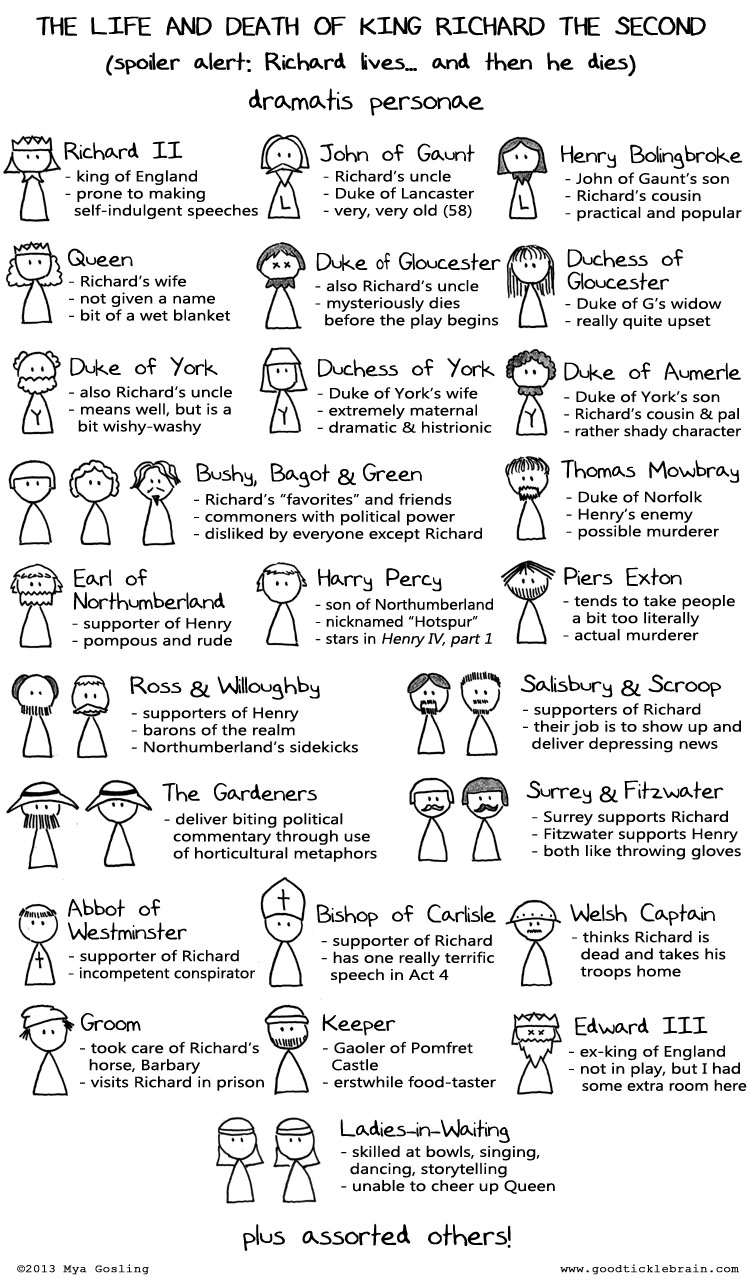
I just discovered a great resource in Good Tickle Brain (goodticklebrain.com) loaded with fun Shakespeare cartoons.

I love this breakdown on Richard II.

Where was this when I was in high school? :/

I Wasted Time, and Now Doth Time Waste Me

Posted in Richard II with tags , , on 2014/03/30 by mattermind

Richard II, Act V


Modern audiences have become so accustomed to sequels that many of us now wait until the end of the closing credits just for a tacked-on bonus scene to tease us for the next installment. While this may seem a decadent byproduct of a Hollywood movie industry in steep decline, it will probably surprise you to encounter the same sort of shenanigans at the end of a Shakespeare history, laying pipe (as screenwriter’s call it) for the sequel by foreshadowing hard times in Henry IV’s near future.

I still find Richard II baffling at the end of the play – both the story and the character. it feels like the middle volume in a trilogy, the tweener neither introducing nor wrapping up the plot’s central conflict. Succession sagas by now have jumped the shark. Richard II is neither heroic nor despicable and definitely not leading-man material. The actions and their consequences are hardly edge-of-the-seat exciting. Even NBC might have to pull the plug. This is not your Blockbuster Event Thrill-Ride of the Summer.

I believe the fault (if indeed it’s a fault) lies with character and not the action. Richard for my money is too wishy-washy for audiences either to fear or sympathize with. His greed and ego prove his undoing, failing to endear him with his subjects…or us. In Act V he gets murdered by a couple of Henry’s lackeys and I confess to not getting worked up about it. Even the play’s central tragic plotpoint turns on an accidental misunderstanding. Yawn.

Must not have been sweeps week at the Globe.

Not knowing the history behind Henry IV’s reign, I can only guess that things will not go so well moving forward. When the inevitable happens, I’ll surely experience an epiphany tracing back to Richard II when I shout out – hopefully not in a crowded theater – how now I understand why, alas, poor Henry was fated to the horrors that befall him.

For now, I’m left with few fond memories of Richard, but certainly with a great deal of exciting dread for the new guy on the throne, Henry. Richard II may ultimately have been a bit of a letdown, but I have high hopes for Richard II: II.

Coming this April to a blog near you. Rated PG13. Viewer discretion advised.

What Subject Can Give Sentence On His King?

Posted in Richard II with tags , , , on 2014/03/28 by mattermind

Richard II, Act IV

Act IV is remarkably short, but adds in oddity what it lacks with brevity.

Backed into a corner, Richard chooses to flee rather than fight a battle he will clearly lose.  Although he is advised that there is more honor in noble defeat than cowardly retreat, he proves a non-starter in the knightly credo.

It’s fitting, after all, for he has engendered the anger of his subjects by being both haughty and self-serving. So it’s doubtful that he will fulfill any commitment to spiritual seeking in his self-imposed isolation.  And, indeed, he sends word to Bolingbroke that will surrender the crown of his own accord and allow the newly-minted Henry IV to send him off whither he will (only to have that turn out to be a short trip to the Tower – yikes.)

Yet Bolingbroke/Henry proves unlike many we have seen in his place.  Not only does he wish no harm unto the deposed king, but he even offers to surrender his claims should Richard merely restore the lands and property that had been rashly seized.  Coming from such a position of strength, it naturally causes quite the stir among Bolingbroke loyalists.  Why bend to his knee now when he has all the momentum to become the new king?

Henry, it seems, knows very well that his actions reinforce a dubious slippery slope that could very well come back to bite him later on.  For what’s to stop the next ambitious type from rising up, gathering followers, and taking rule away from him in turn?

This is where Richard’s sudden and complete abdication in favor of Henry becomes weird.  Because he doesn’t just hand over the crown as he proclaims, but rather he curses Henry and the legacy to follow in a way that can only leave the reader thinking, “Sore loser.”  And yet…the reader also gets the feeling that Shakespeare is setting something up.  And of course, he already knows the history. 

Stay through the credits because there’s a bonus scene (or two) to come.  Shakespeare is already laying the groundwork for the sequel.

Bid Time Return

Posted in Richard II with tags , , , , on 2014/03/27 by mattermind

Richard II, Act III

Many noteworthy novels, plays and movies have taken their titles from lines of Shakespeare – too many to list here (for a complete rundown, see WIKI.) When I stumbled upon the following quote from Richard II, “O call back yesterday, bid time return,” I knew at last where Richard Matheson drew his own title for what became the memorable film, Somewhere In Time.

The original novel, if you can find it, is called, of course, “Bid Time Return.” I tracked it down a long time ago and devoured it, in part because of its fantastic premise, but also because Matheson was one of the most influential novelists of the 20th century (if you doubt me, ask Stephen King).

For those of you unfamiliar with the novel or the movie, this might be a good place to start:

I most remember the novel for a detail that doesn’t end up in the movie. When Richard retreats to an historic hotel to contemplate man’s mortality and the meaning of life, he takes with him the complete symphonies of Gustav Mahler. I had only vaguely known about Mahler before then, but afterwards he became my favorite composer. More than that, one of the most important artistic figures in my life.

I owe that connection to Mr. Matheson, but really so much more. I got to meet him and thank him personally at a screenwriting conference in which he confessed that the inspiration for the story was his beloved wife. Known mostly for his writing on The Twilight Zone and groundbreaking novels of suspense and psychological horror (again, see: King, Stephen) – he winked at the audience and said that every so many years he wrote a love story just for her.

You might know one of these stories since it too is based on a line of Shakespeare: What Dreams May Come.

This is perhaps an overly long introduction to Act III of Richard II. But it’s far too short a reminder of how remarkable a man and writer Richard Matheson was.  He is and will be deeply missed.

As for Richard II, he is neither highly regarded nor much sought after in his absence, save for a small band of loyal followers who are either abdicating to Bolingbroke or losing their heads. The question lingers whether Bolingbroke has a right to do what he’s doing – at least from a legal standpoint. Richard is still hung up about his moral authority as God’s chosen vassal.  He has uttered a few odd curses upon Bolingbroke that to my ears harken back to similar foreboding in Richard III (a play that was written prior to Richard II, though the latter chronologically precedes it).

Richard, however, has an interesting reaction as he slowly wraps his mind around the concept that he is being stripped of his authority. It comes as a bracing shock to him that he might, in fact, be a mere mortal after all, just like everyone else.  He seems to savor the bittersweet schadenfreude of his pending demotion, saying with self-deprecating sarcasm:

KING: Cover your heads, and mock not flesh and blood

With solemn reverence. Throw away respect,

Tradition, form, and ceremonious duty;

For you have but mistook me all this while.

I live with bread like you, feel want, taste grief,

Need friends. Subjected thus,

How can you say to me I am a king?

The revelation in humility would be refreshing if genuine.  But it sounds more like pouting as Richard bemoans his misfortune at the hands of Bolingbroke – neglecting, mind, all he personally did to rile his subjects to turn against him.

Like it or not, however, the question remains, whether what Bolingbroke is just.  Will his actions right the foundering ship of England – or invite ruin upon the land by his quest to unseat a standing king?

We are still a ways from the end…and a definitive resolution.