You Can’t Handle the Truth

Posted in Context, Henry IV Part 1 with tags , , , on 2014/04/07 by mattermind

In trying to make sense of Henry IV, I’m forced to confront larger issues that drive much deeper but are merely tangential to the play.  For instance, how much should the truth matter, especially when these works in particular are called the histories?

I have touched on this subject while reading Richard III.  But now it rears its ugly head again in a big way and I’m not sure what to make of it.  Isaac Asimov, for instance, points out that Prince Hal and Hotspur enjoyed more of a father-son relationship than that of rival brothers.  In fact, Hotspur was two years older than King Edward himself.

It seems Shakespeare couldn’t resist making changes that any modern screenwriter would nod and sympathize with.  These are the very points of contention that critics and fans of the novel (or historical accuracy) will inevitably bring up while slamming the said work with such comments as, “This isn’t anything like the book,” or, “That’s not how it happened.”

Well, Edward IV is another example of this, only by now so much time has passed that the actual history serves almost as a footnote, a marginal amendment applicable to scholars and wonks only.  For the rest of the civilized world, what Shakespeare dramatized has become the gold standard, interchangeable for truth.  But should we be concerned about that?

One could argue that, in making the changes, Shakespeare aspired for dramatic truth – a different form of truth, naturally, but the one nearest to his heart and talents as a playwright.  Why should he concern himself with getting all the niggling details correct?  Especially when that would mean the sacrifice of a good metaphor, irony or parallel construction.  Fudge here, compress there.  That’s how the game works.  And any reasonably literate audience ought to know that.

So why bother calling them the histories then?  Why not fictionalize them entirely, invent characters wholecloth or “based on a true story” instead of trying to have it both ways by capitalizing on the general public’s vague understanding of real events and then distorting them with hyperstylized dialogue and action?

Ultimately, I cannot escape the gravity of this rhetorical black hole.  Shakespeare wrote the plays that we call the histories which historians know are based on errors of source and errors of choice.  But then there are the plays, masterpieces unto themselves.  Why rail at Shakespeare when we can benefit from both with a little education or insight?

Shakespeare Selfies

Posted in Links on 2014/04/06 by mattermind

Selfies

As I noted in a previous post, I have become quite the fan of the artist behind goodticklebrain.com. Happily, she has allowed me to feature some of her work here.  As I progress through the plays, I shall be including more of her brilliant cartoons targeting the specific titles and characters that I’m covering.

The drawings may look simple, but a lot of thought goes into them. I have told her that they remind me of the early work of MATT GROENING.  We all know how that turned out. 😉

I highly encourage you to explore her site (she does other cartooning – and writes well too!) and give her a shoutout for her efforts and all-around brilliance. She’s doing some tremendous things.

For a more extensive look, here is a nice write up that appeared in my ZITE feed. This girl is going places!

Selfies Pt. 2

Scheduling Update

Posted in Henry IV Part 1, Syllabi with tags , on 2014/04/05 by mattermind

Something Orson Welles said about Falstaff (see yesterday’s blog post) slapped me in the face and caused me to completely revise my schedule for the month of April.

Late in the clip, while discussing the bloody battle scene, he remarks that this moment divides the middle ages and the modern (or something to that effect). Neither war nor human psychology would ever be the same.

His thoughts deserve revisiting, and this cycle of plays cries out for in-depth study and analysis. I’ve reached one of those places on my Eurail tour when I must put down roots or risk turning the entire journey into a farce.

You can’t rush ancient Rome or Prague or Vienna or Budapest. I haven’t embarked on studying Shakespeare merely to rubberstamp my passport with a few colorful entry visas.

I have vowed that when I encounter a mountain I shall climb it. Here is such an Everest and Kilimanjaro. The extra effort required to ascend its peak will be worth it. [Peter Matthiessen died today. R.I.P., dear remarkable soul.]

Therefore I have shoved Henry VI until later, bookending it with Henry VIII. Thematically this actually makes sense because it juxtaposes one of Shakespeare’s earliest plays with one of his last. I look forward to a side-by-side comparison.

April now transforms into the “Henriad” or my own personal Hollow Crown adventure. In keeping with that spirit, I have ordered the complete DVD series.

Yup. I’m excited. I love when my assumptions are challenged, my thinking expanded by new doorways that demand venturing through.

April has taken on a whole new meaning.

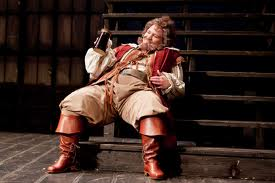
The Enormity of Falstaff

Posted in Henry IV Part 1 on 2014/04/04 by mattermind

Falstaff

In attempting to wrap my mind around Shakespeare’s titanic Henry IV, I have encountered a profound detour that I never expected. Turning to my dear Sir Isaac Asimov, my guide throughout this project, I discover over one hundred pages of a tome encompassing all the plays has been dedicated to Henry IV, Parts I & II alone.

Dissertations have been written on the character of Falstaff, so I will leave it to Mr. Orson Welles to provide our introduction:

I mentioned previously, rather tongue-in-cheekily, that the pattern of Shakespeare’s history plays had become all-too predictable.  Succession issues dominate, with the result that we come to understand that the crown sits precariously on the head of any man (or woman) who wears it.

Yet were these intended to be moral fables? Are we meant to draw lessons from them that can be applied to the present?  Shakespeare’s present? Ours?  In pouring through Shakespeare biographies, I have learned that the art of playwriting itself has had a moralistic evolution, being shaped by the pedagogical impulses of the Church.  That is, after the end of the classical period, of course, and the rise of the middle ages. It was expected, leading up to Shakespeare’s age, that staged fables would portray virtue and vice, sin and redemption, impart aspects of dogma to the large swaths of the population which could not read or write (and who may have avoided quasi-mandatory church service).

That was all radically changing, especially in cosmopolitan centers such as London.  But Shakespeare elevates his aim to a whole new level.  His plays don’t just summarize life or render it in homilies or pave it into pat clichés. No…somehow, rather, through his genius for the invention of characters, he holds a mirror to life and projects it onto the stage in three dimensions.  He presents us with complete beings such as Falstaff and Prince Hal, men (and women) who are burdened with mighty faults as well as gifted with soaring abilities, multi-layered, multivalent beings driven by complex motivations.  We cannot flatly state whether they are either good or bad, wearing a white hat or black.  They don’t represent a type.  In Shakespeare’s hands they become a type unto themselves.

Thus, we can drop the names Lear, Hamlet, Othello, Macbeth, Romeo, Falstaff and they mean something, stand for a unique person as well as idiosyncratic way of being.  There is no other writer in any language for whom it can be stated so unequivocally and triumphantly that he invented an entire spectrum of characters who have become as real to us through time as anybody who ever lived.

The Hollow Crown

Posted in Performance with tags , , , , , , on 2014/04/03 by mattermind

In order to boost my page hits and thus (I hope) internet popularity, I have decided to take off the gloves and begin relentlessly posting the whereabouts and personal endeavors of Tom Hiddleston and Benedict Cumberbatch.

No, not really. But I have noticed that women seem to flock to these two men in inordinate numbers and with all-consuming passion. Must be nice (I guess) for those guys. But they’ve certainly created a mini cottage industry on the pop-culture front.

Mind you, I have nothing against either one of these gentlemen. And women certainly have the right to gush over whomever they choose. I find it funny, though, as an aside, how men are habitually taken to task for objectifying attractive females, while packs of howling females are encouraged with Oprah-esque fist bumps and “you go, girls.” What do I know. Maybe in the end that helps restore balance in the cosmic order.

I already sense what’s coming…I’m going to hear all about how talented these two thespians happen to be…and how female fans have been won over not by physical assets but by profound inward qualities, a reserved thoughtfulness, a je ne sais quoi.

Be that as it may. I’m not here to argue or to criticize. Nor am I actually going to start inserting hunk-of-the-days randomly into blog posts. I just happened to stumble upon what looks to be an utterly fantastic BBC series called “The Hollow Crown,” adaptations of Richard II, Henry IV Parts I & II and Henry V.

Yeah, you could say this is fortuitous timing. Now I just have to find a way to get ahold of them in a hurry. 🙂

So call it coincidence, then, that one of the series’ big stars happens to be, ahem, Mr. Hiddleston. Go ahead, ladies, I won’t mind if you swoon. Heck, if he brings (or brought, the series already ran) a bunch of new eyeballs to Shakespeare’s lesser-adapted history plays, sobeit.

Turnabout is, after all, fair play. I’ll adjust, I suppse, to such Amazon reviews as “I’m only watching it for the beautiful men.” Yes, I get the point.

It’s a brave new world, with age-old gender barriers and stereotypes crashing all around us. Though I wonder sometimes how much really changes beneath the surface – I believe we are to a great extent biologically driven and intellectually/spiritually modified – nobody paying a modicum of attention to what’s happening around us can deny that women are redefining norms faster than we understand what they’re being replaced by. Western culture is definitely in transition.

Oh, by the way…Sam Mendes (of American Beauty and Skyfall fame) executive-produced the Hollow Crown series. Just in case, you know, you might feel the need to still justify that next Hiddleston indulgence.

Just sayin’.

Henry IV or Bust

Posted in Henry IV Part 1 on 2014/04/02 by mattermind

Henry IV, an Introduction

I have entered strange, new territory with Henry IV – and clearly I’m not prepared. I read and reread Act I trying to make sense of it, but there are simply too many moving parts to comprehend the whole at first go.

I’m wondering what happened, how the heck Shakespeare pulled the rug out from beneath me so suddenly. I expected such an easy transition from Richard II…after all, King John and Richard had proven relatively straightforward, even a tad staid and underwhelming (if ever Shakespeare can be that). Now, as if to remind me what an overwhelming force the Bard can be, I face complexity within complexity, like a schoolboy encountering him for the first time. I’m scrambling for a roadmap, a map to the stars, a way to contextualize the plot, the characters, the motivation…everything!

How in the world did this happen? I’m going to have to retrench my approach to this set of plays, hunker down as if studying for college midterms. This may very well be the dreaded downside to having chosen to read the histories in chronological rather than written order. I haven’t encountered a multi-part plot before this (Henry VI being the first that Shakespeare wrote, which I’ll only get to later).

Clearly Shakespeare has upped the ante and deepened the game. This, kids, is a warning against the decision I made. For it’s almost as though I were dealing with a completely new author; his craft is now engaged at full tilt. I feel as though I’ve been ambushed, caught in a heavy intellectual crossfire, overwhelmed and outmatched by superior linguistic and substantive forces. Or, shorter: I have literally no idea what’s happening – or why.

To be honest, I knew I had ventured in over my head the moment I got a gander of the cast of characters. Everyone with a smattering of Shakespeare knows that Falstaff is one of his greatest creations. I had been so looking forward to meeting him that I forgot that he came wrapped in a two-part history, assuming – rather arrogantly and falsely – that our introduction would be a breeze, more like running into Romeo for the first time than, say, Hamlet.

Boy was I wrong! As a result, I am caught with my britches slung around my ankles, undressed by the boldness, complexity and uniqueness of the individual voices assaulting my comprehension. Somewhere Harold Bloom is laughing.

Call this then my complete whiff at Shakespeare, a brush (not the first, and certainly not the last) with abject humility.

I am left utterly speechless…breathless…gasping…lacking anything substantive to say. (Though wags may argue this awareness should have dawned long ago – and that I just missed it.) I feel it now though – oof. This one hurts. My kingdom for a credible metaphor.

I will rise to this challenge. But first I must find a way into the play…and fast!

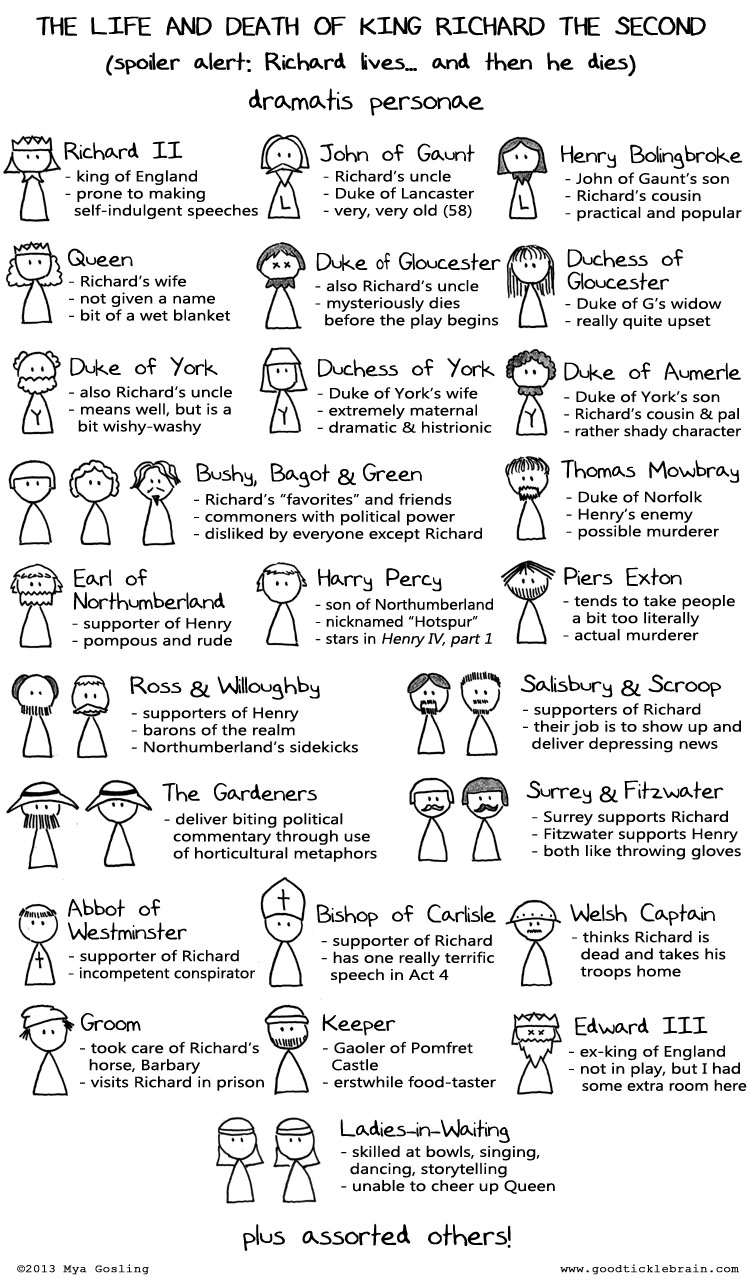
Richard II Explained

Posted in The Plays on 2014/04/01 by mattermind

I just discovered a great resource in Good Tickle Brain (goodticklebrain.com) loaded with fun Shakespeare cartoons.

I love this breakdown on Richard II.

Where was this when I was in high school? :/

Month Three: A Summary

Posted in Monthly Summary on 2014/03/31 by mattermind

After month two, I confessed to experiencing a bit of “Shakespeare fatigue.”  I had been hitting the material hard, coming at it from as many different angles as possible.  The downside? My own writing suffered and I felt conflicted, wanting to produce my best efforts on both fronts.

Now, at month three, I feel refreshed.  A major decision to pursue the historical plays in chronological order, rather than the order in which Shakespeare wrote them, has turned out to be transformational.  My eyes have been opened in particular to England in the middle ages and the development from feudalism to the Renaissance.

In the coming days, I will update my progress on Shakespeare’s biographies.  I’m excited about starting Henry IV and pushing on toward the sonnets, poems and major tragedies to come.  I’m only one quarter of the way through the year.  There is much work – as well as a major celebration – on the near horizon.

The biggest impact Shakespeare has had on me personally is to change the way I view drama, whether it be on stage, in movies or on TV.  I’m a lot harder to please, I think.  Some might even say cranky.  I can’t help but compare what I encounter to Shakespeare – and of course the majority of that will wind up lacking.  I have unwittingly set the bar ever higher, just because Shakespeare has become an everyday phenomenon in my life.  I brush my teeth thinking about Othello or Titus or Richard II.  I go to sleep with thoughts of Desdemona.  It’s hard to all of a sudden just let that go.

As I noted previously, Shakespearean language becomes more familiar even when the exact meaning of archaic expressions remains elusive.  I bother with footnotes less, depend on context to provide the gist and continue reading.  There are times when I need to parse a phrase or delve into research material to explicate a contextual reference; that’s because Shakespeare draws from such a wide pool of knowledge and employs a vaster working vocabulary than any other writer who ever lived.  He invents words, spins them in novel phrases with metaphorical and poetical panache.  I scramble to make sense of much of it.  But on the whole I feel freer to savor sounds as if basking in a foreign language or sitting by a babbling brook.  Somehow the overall meanings manage to trickle through.

I seldom doubt whether the project has personal significance, but I have become skeptical whether the blog makes any sort of difference to others.  That makes it hard sometimes to stake out the necessary time and space to give each entry my all.  I wanted the positive pressure of committing to a daily task with public accountability on a highly-visible blog…but I failed to grasp how even that might not prove incentive if nobody shows up to read what I’ve done.

That’s not the internet’s fault.  I simply haven’t produced content that people care about.  Maybe that means I need to rethink my strategy.  Or maybe it’s the format.  Or it could be my voice.  I don’t know exactly.  It’s another barrier I have to push through.

I care a lot.  Maybe I get too wrapped up on whether what I’m doing is connecting to others.  I get excited when people plug in and we share a virtual connection through Shakespeare’s words.  I wish sometimes that I had set the whole year aside for only Shakespeare.  That would be my advice to anybody considering a similar project: take the entire 365 days and turn it into a book or documentary or diary.  Don’t add it to whatever else you have going on or you may find yourself pressed from two many competing priorities.  Shakespeare demands the best of our intellect and our passion.  Doing this halfheartedly is almost worse than not bothering at all.

Here’s to the next quarter, I guess.  Spring has sprung.  One more month and I begin the sonnets, poems and Romeo and Juliet!

I Wasted Time, and Now Doth Time Waste Me

Posted in Richard II with tags , , on 2014/03/30 by mattermind

Richard II, Act V


Modern audiences have become so accustomed to sequels that many of us now wait until the end of the closing credits just for a tacked-on bonus scene to tease us for the next installment. While this may seem a decadent byproduct of a Hollywood movie industry in steep decline, it will probably surprise you to encounter the same sort of shenanigans at the end of a Shakespeare history, laying pipe (as screenwriter’s call it) for the sequel by foreshadowing hard times in Henry IV’s near future.

I still find Richard II baffling at the end of the play – both the story and the character. it feels like the middle volume in a trilogy, the tweener neither introducing nor wrapping up the plot’s central conflict. Succession sagas by now have jumped the shark. Richard II is neither heroic nor despicable and definitely not leading-man material. The actions and their consequences are hardly edge-of-the-seat exciting. Even NBC might have to pull the plug. This is not your Blockbuster Event Thrill-Ride of the Summer.

I believe the fault (if indeed it’s a fault) lies with character and not the action. Richard for my money is too wishy-washy for audiences either to fear or sympathize with. His greed and ego prove his undoing, failing to endear him with his subjects…or us. In Act V he gets murdered by a couple of Henry’s lackeys and I confess to not getting worked up about it. Even the play’s central tragic plotpoint turns on an accidental misunderstanding. Yawn.

Must not have been sweeps week at the Globe.

Not knowing the history behind Henry IV’s reign, I can only guess that things will not go so well moving forward. When the inevitable happens, I’ll surely experience an epiphany tracing back to Richard II when I shout out – hopefully not in a crowded theater – how now I understand why, alas, poor Henry was fated to the horrors that befall him.

For now, I’m left with few fond memories of Richard, but certainly with a great deal of exciting dread for the new guy on the throne, Henry. Richard II may ultimately have been a bit of a letdown, but I have high hopes for Richard II: II.

Coming this April to a blog near you. Rated PG13. Viewer discretion advised.

Will’s Will

Posted in Shakespeareana, Uncategorized on 2014/03/29 by mattermind

Ever since hearing way back in what must have been junior high or high school that Shakespeare left his “second-best bed” to his wife, I (and, admit it, you too) have been curious what else the Bard bequeathed to his family and friends.

To humanity, of course, he left the greatest plays in the English language. But if you’re more fascinated by the everyday/tawdry bits, you can now read his last will and testament online for the first time.

Click HERE to learn more from the Coventry Telegraph.